
Agentic commerce · Send247 research
How agentic commerce will disrupt e-commerce inventory, and the role of logistics
Within the next 36 months, you may never manually search for a product, compare shipping costs, or tap a “Buy Now” button again. Autonomous AI agents are quietly taking over the transactional engine of our daily lives, and the brands that fail to wire themselves for agentic commerce today will be completely invisible tomorrow.
Forward-thinking businesses are looking to embed purchases inside AI conversations and share their catalogue with AI agents.

Founder, Send247
Published 6 min read
Key takeaways
- Agentic commerce is shopping completed by autonomous AI agents on a buyer’s behalf. McKinsey estimates it could unlock $3 trillion to $5 trillion in global transaction volume by 2030.
- Buying a physical item takes a protocol stack: MCP for catalogue access, A2A payments, A2P human approvals and fulfilment at the end.
- The biggest gap today is real-time inventory. Traditional feeds refresh every 6 to 24 hours, which can break an autonomous purchase.
- Trust depends on the monitoring delta: the wait between delegating an order and knowing it succeeded. Two-hour delivery shrinks it from days to hours.
- Retailers can test whether AI agents can find and transact with their store at send247.uk/ai-ready.
Question 1
We hear a lot about AI transforming everyday life. How quickly are consumers actually delegating shopping to AI agents?
The shift from AI as a conversational novelty to AI as an operational delegate is happening faster than any prior technology adoption curve. Consumers are actively outsourcing high-stakes emotional, operational and commercial tasks.
- Shopping and recommendations: over 54% of digital shoppers use generative AI to filter recommendations, compare product specs and curate specialised shopping baskets rather than browsing traditional e-commerce search engines.
- Orders generated through AI-powered Shopify searches increased 8x from 2025 in Q1 2026.
- 23% of US consumers already trust generative AI to conduct payments.
Question 2
What is “agentic commerce,” and what does the market scale look like?
Agentic commerce refers to transactions initiated, evaluated, negotiated and completed by autonomous AI agents on behalf of human buyers.
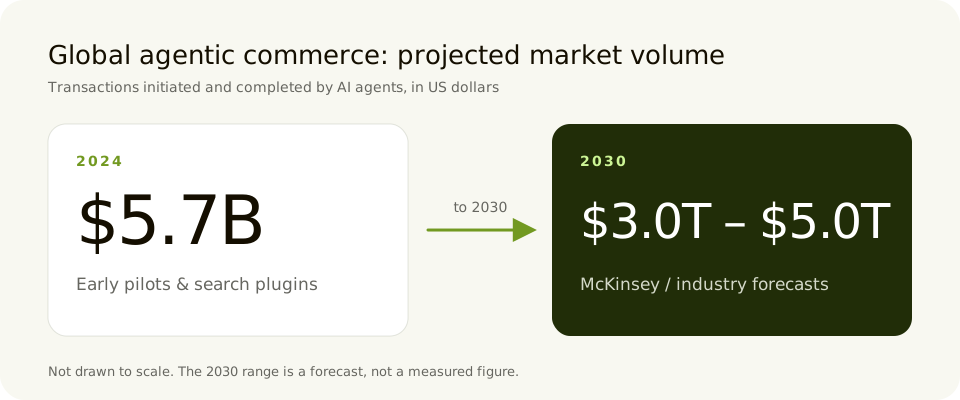
McKinsey estimates that agentic commerce will unlock $3 trillion to $5 trillion in global transaction volume by 2030.
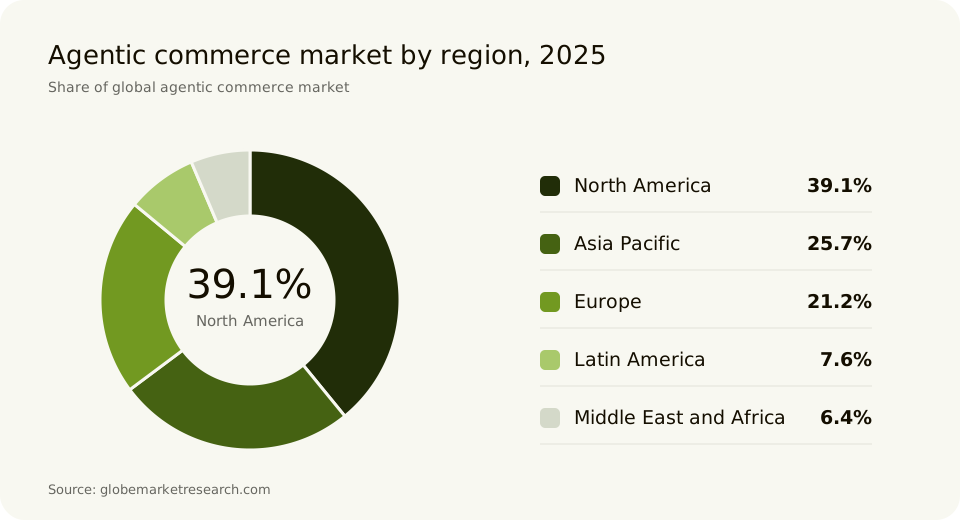
To put this in perspective:
- Referral traffic: generative AI-driven referral traffic to US retail websites surged 693.4% year over year during peak holiday shopping. Visa’s 2025 survey of 3,700 online shoppers found that two in three already use AI shopping agents to save time or find better prices.
- Claude and Muse commerce data: enterprise platforms using models like Claude and specialised retail engines (such as Muse) report a 4x year-over-year surge in API calls structured for cart building, inventory lookup and automated checkout protocol handshakes. AI agents are now capable of end-to-end autonomous shopping journeys.
- Corporate readiness: Kearney’s State of Agentic Commerce 2026 shows a wide gap between strategy and execution among consumer-goods companies, with very few running a live agent offering. The table below sets out the detail.
How ready are consumer-goods companies?
Kearney benchmarked 106 companies between September 2025 and August 2026. The table shows the share of companies in each product category at each readiness stage.
| Readiness ascends → | |||||
|---|---|---|---|---|---|
| Category analysed(number of companies) | No mention of AI | General use of AI in business | AI use in commerce | Agentic commerce strategy | Live commerce agent offering |
| Beauty and personal care10 companies | None | 40% | None | 50% | 10% |
| Snacking and confectionery8 companies | 12% | 12% | 38% | 25% | 12% |
| Pet care3 companies | 33% | None | None | 67% | None |
| Home care and HPC8 companies | None | 12% | 38% | 50% | None |
| Alcoholic beverages7 companies | 14% | 29% | 29% | 29% | None |
| Non-alcoholic beverages4 companies | 25% | 25% | 25% | 25% | None |
| Tobacco/nicotine5 companies | 20% | 40% | 20% | 20% | None |
| Packaged food8 companies | 25% | 50% | 12% | 12% | None |
Eight categories shown (53 companies); “–” means no company in that category sits at that stage. Percentages are the share of each group at that level and may not total 100 because of rounding. Based on investor communications and public company statements across own channels and business media. Multi-category companies are assigned to the category of their largest business unit. Recreated from Kearney, State of Agentic Commerce 2026.
Only two of the eight categories have any company with a live commerce agent offering: beauty and personal care (10%) and snacking and confectionery (12%). Pet care has the highest share at the agentic strategy stage (67%), but that is two of just three companies, so treat the category-level percentages as directional rather than definitive.
Question 3
Under the hood, how does an AI agent actually purchase a physical item? What protocols make this work?
Moving from a simple chat prompt to a physical item arriving at your front door requires a complex stack of emerging open protocols.
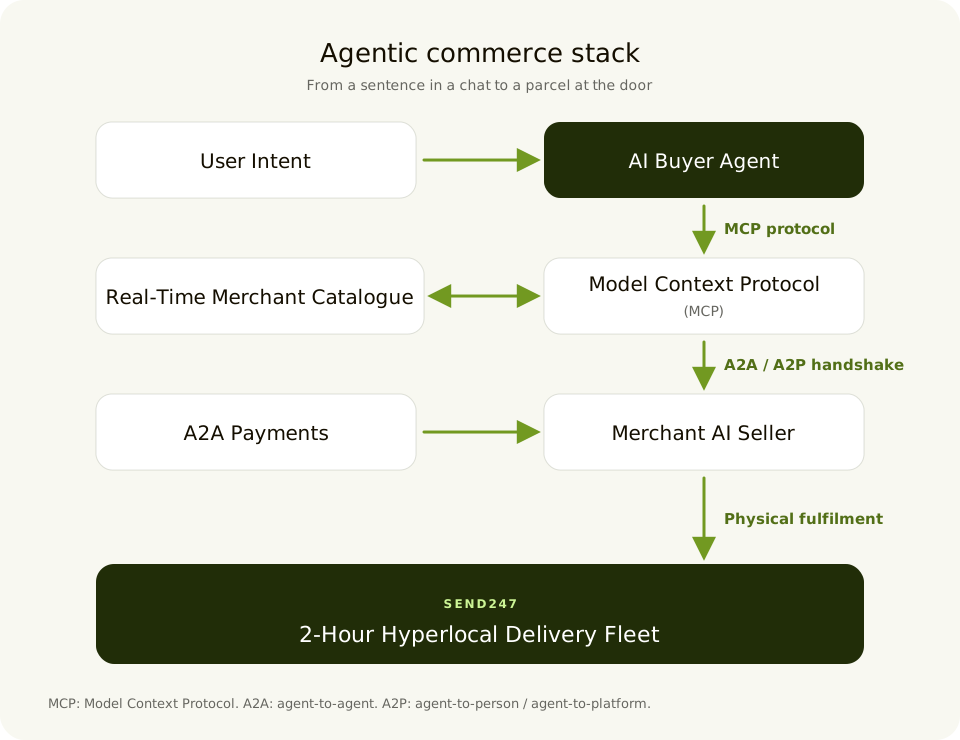
- Model Context Protocol (MCP): developed by Anthropic and supported across the ecosystem, MCP acts as the universal adapter connecting AI agents directly to real-time enterprise databases, inventory feeds and store platforms without custom API engineering. Read the MCP specification.
- A2A (agent-to-agent) payments: standardised financial rails that allow a buyer’s agent to negotiate, authorise tokenised funds and execute transactions directly with a merchant’s seller agent.
- A2P (agent-to-person / agent-to-platform): protocols that manage human-in-the-loop approvals, step-up biometric authentication and delivery receipt confirmations.
- Catalogue scale: in major commercial capitals like London, agents must instantly query and evaluate the active SKUs spanning local retail shops, high-street hubs and regional distribution centres.
To check whether a web storefront can communicate with autonomous buyers, tools like Cloudflare’s isitagentready.com scan site discoverability, content accessibility, bot access controls, protocol endpoints and commerce support.
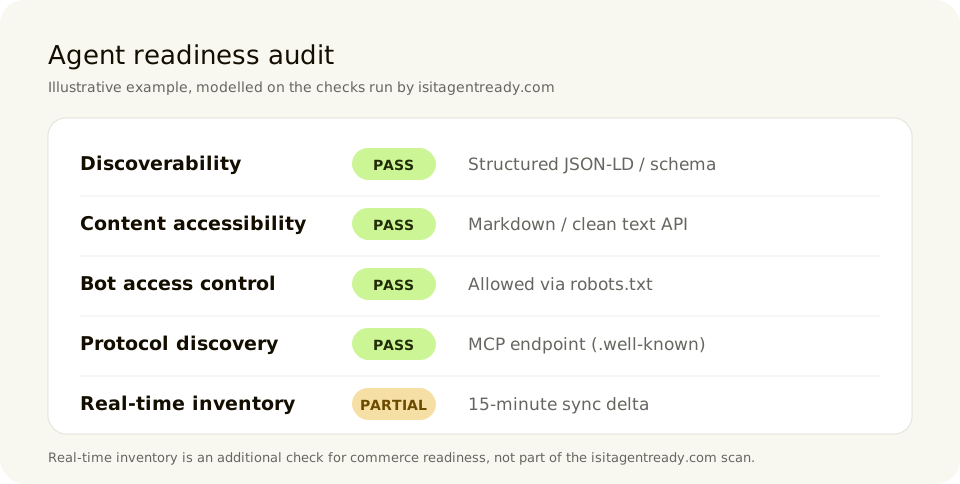
Send247 publishes its own agent-facing documentation, including MCP server docs and an API reference. You can test your own catalogue at send247.uk/ai-ready.
Question 4
Is the infrastructure ready today, or is it mostly hype? What is missing?
The infrastructure is partly ready.
The reasoning engine (LLM intelligence) is sufficiently smart, and the physical delivery networks exist. However, the critical missing link today is reliable, real-time inventory synchronisation.
Traditional e-commerce feeds rely on batch updates that refresh every 6 to 24 hours. If an AI agent purchases an item that is out of stock in the physical store, the entire autonomous loop breaks. At Send247, we bridge this inventory accuracy bottleneck by integrating live Google Shopping data feeds alongside our direct merchant API pipelines, ensuring high-fidelity stock matching before an agent places an order.
Question 5
What are the two core hurdles standing between current AI tools and mass consumer adoption?
The battle for agentic commerce comes down to two sides of the same coin.
- Infrastructure side (wiring it together): connecting disparate product catalogues, tokenised payment gateways, local stock management and last-mile dispatch into a zero-latency pipeline.
- Consumer side (trust): handing credit card authority to an autonomous assistant requires absolute confidence that the agent won’t buy the wrong item, overpay or fail silently. Customers expect an AI-assisted purchase to be “fire-and-forget”.
Question 6
What is the “monitoring delta,” and how does Send247 solve it?
When a user instructs an AI agent to order a product, they enter the monitoring delta: the nerve-wracking window of time between delegating the task and confirming whether it succeeded or failed.
If an agent takes 24 to 48 hours to fulfil an order and fails at the final step, the user’s trust in autonomous commerce vanishes.
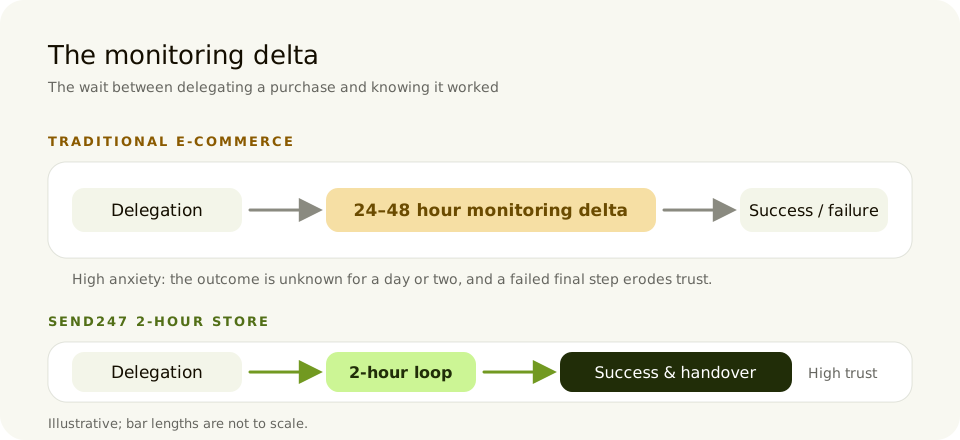
At Send247 Shop, we believe the time to failure and recovery must be minimised to near zero. This is why Send247 is branching directly into agentic commerce with the 2-Hour Store. By combining real-time inventory verification with instant, 2-hour physical delivery, we shrink the monitoring delta to an absolute minimum. If a stock discrepancy occurs, the client and agent are notified immediately, resolving issues in minutes rather than days.
Question 7
How is trust maintained throughout the entire order life cycle?
Trust is built through radical transparency.
Every single step taken by the AI agent, from inventory verification and A2A payment authorisation to real-time courier dispatch and delivery tracking, is exposed via step-by-step notification channels. The customer retains full oversight without having to manage the tedious manual steps.
As physical logistics meet autonomous intelligence, Send247 is building the underlying rails for an agent-ready retail ecosystem.
Sources and further reading
- McKinsey, The agentic commerce opportunity: the $3 trillion to $5 trillion global estimate for 2030.
- Kearney, The state of agentic commerce: readiness benchmark of more than 100 global companies.
- Model Context Protocol: the open standard for connecting AI agents to data and tools.
- isitagentready.com: agent-readiness scanner for web storefronts.
- Regional market split: globemarketresearch.com.
About the author
Mark Okiki
Founder, Send247
Mark founded Send247, a London business logistics service focused on same-day delivery for businesses, including pharmacies. Send247 is building delivery rails for agent-ready commerce.
Mark Okiki on LinkedIn